
Implants are artificial tooth roots placed in the jawbone to support prostheses. These long-lasting artificial roots, which replace missing teeth and can be used for a lifetime, allow for the placement of fixed or removable prostheses, restoring the patient’s chewing function and aesthetics.
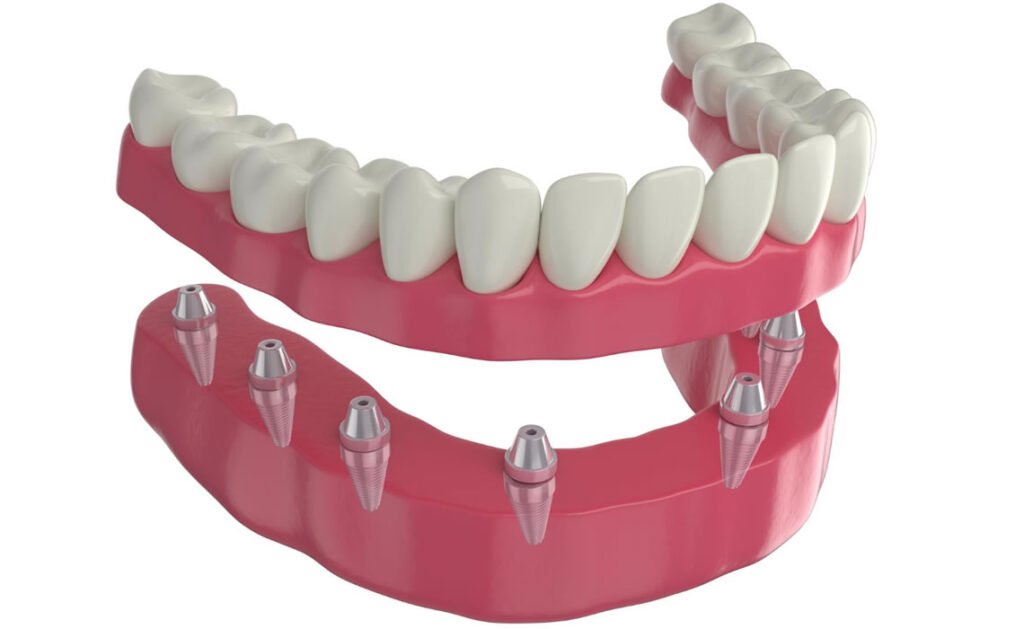
In cases of complete tooth loss in the upper and lower jaws, or when the patient cannot use a full prosthesis due to excessive bone loss, implants are used to increase retention by placing the prosthesis on them.
If the posterior region ends in edentulousness due to the loss of molars, a fixed bridge can be made on several implants instead of a removable partial prosthesis.
In long edentulous spaces, the length of bridges can be problematic. One or more implants placed in the edentulous area can increase the support and durability of long bridges.
In cases of single tooth loss, a single implant can be placed in the missing tooth and a single crown can be placed on it, without the need to reduce the size of the teeth on either side of the missing tooth.
The integrity of the implant and the prosthesis to be placed on it is very important. The design of the implant screw and the intermediate parts to be selected during the prosthesis phase are crucial for the long-term success of single implants.
The prosthetic part of the implant should not loosen and fall out.
If possible, the adhesive (cemented) method should be avoided.
If preferred, adhesive residues must be cleaned very thoroughly to avoid damaging the bone around the implant.
In patients who grind their teeth, attention should be paid to the porcelain design.
Food particles should not accumulate around the implant and between the teeth.
Thanks to implant treatment, the use of bridge treatments, which were frequently used in the past, has rapidly decreased. Implant treatments have brought an end to the era of cutting down two adjacent teeth and using them as bridge abutments due to the loss of a single tooth. With implant treatment, a single tooth gap can be filled without damaging adjacent teeth. It is easier to maintain and clean compared to bridges. Implant treatment has the function of a natural tooth and offers the same appearance. It is almost impossible to distinguish an implant treatment from a natural tooth.